


Why does the shower get dirty?
There are some details we only notice when they start to bother us, or when we are about to have friends over and want everything to sparkle. One of them is how clean the shower is and how well it works.
The truth is that a lot of dirt can build up in the shower, caused by hard water, residue from soap, shower gel or shampoo, and constant humidity. Over time, limescale and other residue can clog the nozzles and reduce the water flow, affecting the efficiency and lifespan of the fitting.
Most of these problems can be avoided with regular shower cleaning, ideally with a quick wipe after each use. In this guide, we explain how to clean the shower step by step, how often to do it, which products to use safely and how water quality affects the result.


What types of dirt build up in the shower?
The shower can collect different types of dirt over time:
- Limescale in the shower: white deposits that form in the holes of the shower head and block the flow of water.
- Mould and mildew in the shower: dark stains that appear on the joints and around the connection to the hose, encouraged by constant humidity.
- Soap and shower gel residue: this creates a sticky film that restricts the flow of water and makes the shower look dirty.
Recognising each type of dirt helps you choose the most suitable cleaning method and prevent premature wear of the fitting.
Simple tips to prevent dirt in the shower
Anything repeated often enough becomes a habit, and a habit is kept up with almost no effort. Besides, prevention is far better than cure. So follow these guidelines:
- Give the shower head a quick wipe with a damp cloth after each use, whenever possible, to remove residue before it dries.
- Dry the outside with a soft cloth to prevent stains and mildew.
- Periodically remove and take apart the shower head and clean the nozzles to prevent residue from building up.
- Use filtered or softened water to reduce limescale deposits in the shower.
- Let the bathroom air after showering, by opening the window or switching on the extractor fan, so that humidity does not build up.
Why not get into the good habit of cleaning the shower and preventing dirt, especially if you have a good-quality fitting?

How to clean the shower effectively?
When the dirt is already visible, shower cleaning needs to go deeper. Start by choosing the right product for the type of dirt and the material of your fitting.
Which products should you use for shower cleaning?
- White vinegar or lemon: their acidity helps dissolve limescale deposits in the shower.
- Bicarbonate of soda: made into a paste with a little water or lemon juice, it is useful for removing stains and restoring shine, with a slightly abrasive action.
- Commercial products: specific shower cleaners and household descalers, safe for both plastic and metal. Always follow the manufacturer’s instructions.
A useful note: vinegar is acidic and bicarbonate of soda is alkaline, so they work best when used at different times, rather than mixed together beforehand in the same container.
How to clean the shower step by step
- Step 1, take it apart: turn off the water and unscrew the shower head from the flexible hose. Remove the filter or inlet mesh, if there is one.
- Step 2, apply the product: soak the shower head in white vinegar, lemon juice or a descaling product.
- Step 3, leave it to work: with vinegar or lemon, leave it for 30 minutes or longer if needed. With commercial products, follow the time indicated by the manufacturer.
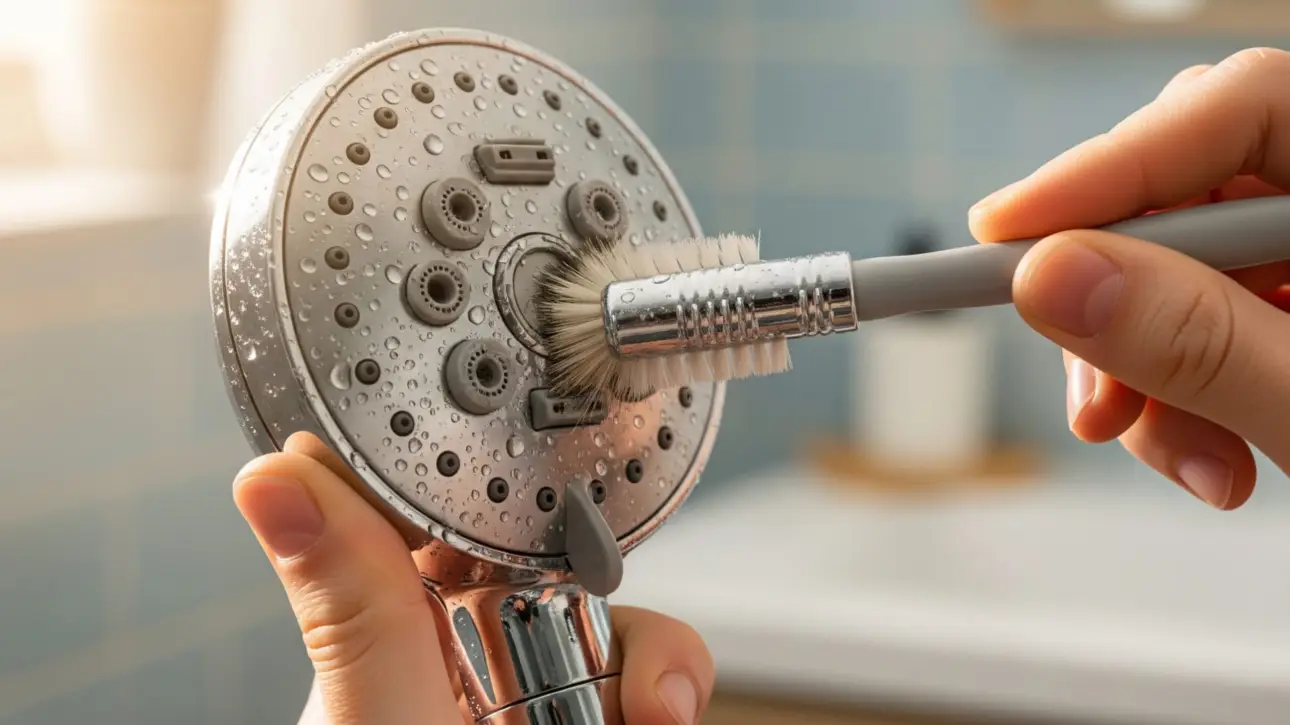
- Step 4, scrub: scrub the surface and the jets with a soft toothbrush to loosen any remaining residue.
- Step 5, rinse and reassemble: rinse thoroughly under running water, put it back together and let the water run for a few seconds to flush out any loose residue.
What if the shower head will not come off?
For fixed showers, you can fill a plastic bag with vinegar, wrap it around the shower head so that the jets are submerged and secure it with an elastic band. After the soaking time, remove the bag, scrub and run hot water to rinse.
How to clean the small holes without damaging the shower?
To clean the small holes, use a fine needle or a toothpick. Do not force it, so as not to damage the nozzles. On many modern showers, the jets are made of flexible rubber and simply rubbing a finger over them is enough to loosen the limescale.
With these measures, you can effectively remove most stains, limescale and mildew from the shower.
Safety precautions with cleaning products
- Never mix bleach with vinegar or other acidic products, such as some toilet cleaners and rust removers (check the label to see whether your descaler is acidic): the mixture releases chlorine gas, which, according to the CDC, irritates the airways and can cause coughing and breathing difficulties.
- Never mix bleach with ammonia: the reaction releases chloramines, toxic gases that can cause coughing, shortness of breath, chest pain and irritation of the eyes, nose and throat, according to the Washington State Department of Health.
- Keep the bathroom well ventilated while cleaning, by opening the window or switching on the extractor fan, and wear gloves to protect your skin from splashes, as recommended by the CDC.
- Vinegar and lemon are acidic and may not be suitable for natural stone, such as marble, or for some special finishes (gold, brushed or matt black). If in doubt, test on an inconspicuous area and check the manufacturer’s instructions.
- Always rinse thoroughly between different products and store them out of the reach of children and pets.
- In the event of accidental inhalation, swallowing or contact with a cleaning product in Portugal, contact INEM’s Poison Information Centre (CIAV) on 800 250 250, available 24 hours a day, or call 112 in an emergency.
If you would rather reduce the use of harsh chemicals at home, find out more about the benefits of water rich in ozone and active oxygen for cleaning and discover Filtrarte’s home cleaning solutions.


How often should you do shower cleaning?
Preventing dirt in the shower with a care routine is the best way to extend the lifespan of the fitting. As a practical guide:
- After every shower: wipe the shower head with a cloth and let the bathroom air.
- Every week: give the head and nozzles a light clean and inspection to prevent build-up and blockages.
- Every month: do a deep clean with a descaling product or vinegar. In areas with very hard water, you may need to do this more often.
- When needed: if the limescale in the shower has built up too much or there is corrosion, consider replacing the shower head.
With this simple maintenance, your shower stays clean, working properly and with a good water flow for longer.
Mould in the shower: why should you prevent it?
Mould grows wherever there is moisture, such as the bathroom after a shower. According to the DGS (Portugal’s Directorate-General of Health), excessive humidity can lead to mould growth, with negative effects on the people using the space. Besides looking unhygienic, mould spores can cause allergic reactions in sensitive people and asthma attacks in people with asthma who are allergic to mould, according to the US Environmental Protection Agency (EPA). Prevention therefore deserves extra attention in homes where someone has allergies or allergic asthma.
The same agency explains that the key to mould control is moisture control: increasing ventilation, by opening a window or running the extractor fan, and cleaning more often will usually stop mould from coming back. Drying surfaces and cleaning the joints regularly complete these measures, and the CDC recommends keeping indoor humidity no higher than 50%.
How does hard water affect the shower and your skin?
Hard water has a high concentration of dissolved salts, mainly calcium and magnesium, as explained by ERSAR, the Portuguese water services regulator. When the water heats up or evaporates, these minerals are deposited as limescale on the shower jets, taps, shower glass and inside water heaters and boilers.
On skin and hair, hard water makes soap and shampoo lather less and, according to the WHO, encourages deposits such as the familiar bathtub ring. Some people also notice drier or tighter skin and duller hair, a perception that varies from person to person. As for atopic eczema, the evidence is not yet conclusive: a British study linked harder water to a higher risk of atopic eczema in babies, but a clinical trial of water softeners in children with eczema found no additional benefit over usual care.
If you are unsure about the hardness of the water in your home, you can check the water quality data published by your local water supplier or do a test with measuring strips. In Portugal, ERSAR also publishes a water hardness map by municipality on the same page, as well as the water quality data for each municipality.
Filtered or softened water in the shower: does it make a difference?
Treating water where it enters the home tackles the source of the problem, rather than just dealing with the consequences. A water softener reduces the calcium and magnesium responsible for limescale, which means fewer deposits in the shower, easier cleaning and better protection for appliances that use hot water.
In the Filtrarte range, the Kinetico water softener and the Premier Plus water softener are options designed for the whole home. Filtration systems, on the other hand, mainly act on other parameters, such as chlorine, sediment or taste, and can be combined with softening depending on the characteristics of the water.
To find out which solution suits you best, explore our home water purification solutions and learn more about the main health benefits of filtered water.
Frequently asked questions about shower cleaning
What is the best way to remove limescale from the shower?
Soaking the shower head in white vinegar or a descaling product for 30 minutes or longer, scrubbing the jets and rinsing thoroughly is usually enough. For more stubborn cases, you can repeat the process or leave it to work for longer.
Can I mix bleach and vinegar to clean the shower?
No. Bleach mixed with vinegar or other acids releases chlorine gas, and mixed with ammonia it releases chloramines. Both fumes are dangerous to the airways. Use each product separately and rinse thoroughly between applications.
How often should I clean the shower?
A quick wipe after every shower, a light weekly clean and a monthly descale are a good guide. In homes with very hard water, deep cleaning may need to be more frequent.
Does a water softener prevent limescale in the shower?
A water softener significantly reduces the minerals that form limescale, so deposits in the shower tend to decrease considerably. Regular cleaning is still needed to remove soap residue and prevent mould.
Shower cleaning: small habits for a healthier shower
A little care prevents dirt in the shower, limescale deposits and mould, which affect hygiene and water flow. A clean shower contributes to comfort, efficiency and the lifespan of the fitting.
With quick, regular actions and better-quality water, you can keep your bathroom healthier and avoid long-term problems. After all, a good shower starts with a shower head that is clean, well looked after and has a good water flow.
A shower can be the best and most comforting moment of your day or an unpleasant experience. What kind of experience do you want to create for your next showers?


Want to reduce limescale in your shower and throughout your home? The Filtrarte team can help you choose the water softener best suited to your water.
References
- Centers for Disease Control and Prevention (CDC). Chlorine. 2026. https://www.cdc.gov/chemical-emergencies/chemical-fact-sheets/chlorine.html
- Washington State Department of Health. Dangers of Mixing Bleach with Cleaners. Accessed September 2026. https://doh.wa.gov/community-and-environment/contaminants/bleach-mixing-dangers
- Centers for Disease Control and Prevention (CDC). When and How to Clean and Disinfect Your Home. Accessed September 2026. https://www.cdc.gov/hygiene/about/when-and-how-to-clean-and-disinfect-your-home.html
- Instituto Nacional de Emergência Médica (INEM). CIAV, Centro de Informação Antivenenos. Accessed September 2026. https://www.inem.pt/category/servicos/centro-de-informacao-antivenenos/
- Direção-Geral da Saúde (DGS). Qualidade do ar interior. Accessed September 2026. https://www.dgs.pt/paginas-de-sistema/saude-de-a-a-z/ar-interior/qualidade-do-ar-interior.aspx
- U.S. Environmental Protection Agency. A Brief Guide to Mold, Moisture and Your Home. Accessed September 2026. https://www.epa.gov/mold/brief-guide-mold-moisture-and-your-home
- Centers for Disease Control and Prevention (CDC). Mold. 2024. https://www.cdc.gov/mold-health/about/index.html
- Entidade Reguladora dos Serviços de Águas e Resíduos (ERSAR). Características da água. Accessed September 2026. https://www.ersar.pt/pt_consumidor_qualidade-da-agua_caracteristicas-da-agua.html
- Entidade Reguladora dos Serviços de Águas e Resíduos (ERSAR). Pesquisa por concelho. Accessed September 2026. https://www.ersar.pt/pt_consumidor_qualidade-da-agua_pesquisa-por-concelho.html
- World Health Organization. Hardness in Drinking-water: Background document for development of WHO Guidelines for Drinking-water Quality (WHO/HSE/WSH/10.01/10/Rev/1). 2011. https://cdn.who.int/media/docs/default-source/wash-documents/wash-chemicals/hardness-bd.pdf?sfvrsn=a13853a9_4
- Perkin MR, Craven J, Logan K, Strachan D, Marrs T, et al. Association between domestic water hardness, chlorine, and atopic dermatitis risk in early life: A population-based cross-sectional study. J Allergy Clin Immunol. 2016;138(2):509-16. https://doi.org/10.1016/j.jaci.2016.03.031
- Thomas KS, Dean T, O’Leary C, Sach TH, Koller K, Frost A, Williams HC; SWET Trial Team. A randomised controlled trial of ion-exchange water softeners for the treatment of eczema in children. PLoS Med. 2011;8(2):e1000395. https://doi.org/10.1371/journal.pmed.1000395
By the Filtrarte Expert Team
The information in this article is not intended to recommend any treatment for symptoms or diseases. Consult your doctor for specialist advice.


