Limescale in water shows itself discreetly. You may see a whitish ring around the tap, a kettle with a pale crust on its base or a shower gel that seems to lather less than usual. In areas with harder water, these signs recur throughout the home. They bring costs that are not always linked to the water, from more time-consuming cleaning to wear on appliances. Understanding where limescale comes from, how it shows up and what solutions exist helps you make better-informed decisions with less trial and error. The options range from regular cleaning to a water softener.
This guide explains what makes water hard. It also shows how to recognise the signs in the kitchen, the bathroom, on the skin and in the hair, and how to assess the options for each type of home.
What limescale is and why some areas have harder water
Limescale is the mineral deposit, mainly calcium carbonate, left on surfaces when hard water heats up or evaporates. The expression “hard water” describes water with significant amounts of dissolved salts, essentially calcium and magnesium, while “soft water” contains small amounts of these salts. This is the definition that the Water and Waste Services Regulation Authority (ERSAR), Portugal’s regulator, uses in its consumer materials.
How water hardness is measured
People usually express water hardness in milligrams of calcium carbonate per litre (mg/L of CaCO3). The World Health Organization (WHO) uses four bands in its reference document on the subject. ERSAR also adopts them in the hardness map it publishes for the country:
| Classification | Hardness (mg/L of CaCO3) |
|---|---|
| Soft water | 0 to 60 |
| Moderately hard | 60 to 120 |
| Hard | 120 to 180 |
| Very hard | Above 180 |
Some bills and analyses give hardness in French degrees (°fH). The conversion is simple: according to EPAL, the Lisbon water utility, 80 mg/L of calcium carbonate corresponds to 8 °fH.
Why hardness varies from region to region
Hardness depends above all on the route the water takes before it reaches the tap. The WHO explains that the main natural sources of hardness are metal ions dissolved from sedimentary rocks, mostly limestone and chalk. When water passes through ground rich in these rocks, it dissolves more minerals and reaches homes harder.
In Portugal, this difference shows on the map. According to the analysis by DECO PROteste, the Portuguese consumer organisation, of ERSAR data:
- In the North and Centre of Portugal, the water tends to be softer. Exceptions include Cantanhede, Mira and Alcobaça, where it is very hard.
- In the South, hardness ranges from moderate to very hard.
- In the Lisbon Metropolitan Area, the water is generally soft; Cascais is an exception.
Even within the same municipality (concelho), supply zones may have different values. The most reliable information is therefore always that of the local water utility, as explained further on.
Signs of water with limescale at home, on the skin and in the hair
The signs of water with limescale appear first where water heats up, evaporates or stands still. Recognising them early lets you act before deposits build up.
In the kitchen and bathroom
- White stains and marks on taps, sinks, shower screens and tiles, which reappear soon after cleaning.
- A crust inside the kettle and the coffee machine, sometimes with small flakes coming loose.
- Cloudy glasses coming out of the dishwasher.
- Showerheads with misaligned jets or reduced flow, because the holes gradually become blocked.
- Less lather with soap, shampoo and detergents. ERSAR states precisely that hard water may not lather well with soap, detergents or shampoo. The WHO associates hard water with higher soap consumption.
The Filtrarte article on shower cleaning and limescale prevention details specific shower cleaning, with the recommended products and safety precautions. This guide focuses on the home as a whole.
On the skin and hair
Some people describe a feeling of tight skin after bathing, or rougher, duller hair, in hard water areas. Research helps to understand why, although the conclusions are still limited.
A study in the Journal of Investigative Dermatology, run by the University of Sheffield and King’s College London with 80 participants, found that skin washed with hard water retained more surfactant residue (the component that makes hygiene products lather). This residue was associated with greater water loss through the skin and more irritation. When ion exchange softened the water, these effects diminished. The authors themselves stress that practical conclusions need intervention studies. A water softener manufacturer funded the work.
As for hair, a study in the International Journal of Trichology, with samples from 70 participants, observed lower tensile strength in strands exposed to very hard water. The authors acknowledge that other studies have reached different results. They add that the mechanism is not yet clear.
In practical terms, these findings help to explain some everyday sensations. They do not allow the water to be blamed as the cause of skin or hair problems. If you have very dry skin, persistent itching or hair loss, you should speak to a doctor or dermatologist.
Effects of limescale on appliances and plumbing
Limescale builds up above all in equipment that heats water, because higher temperatures favour the precipitation of minerals. The WHO states that hard water can cause deposits in the distribution system. It adds that softening reduces scale formation in pipes, taps and water heaters.
In everyday household terms, the most exposed points are:
- Hot water cylinders, water heaters and boilers, where limescale settles on the heating surfaces.
- Washing machines and dishwashers, with heating elements and internal circuits prone to scaling.
- Kettles, coffee machines and steam irons, which concentrate minerals with every use.
- Taps, mixers and showerheads, where deposits reduce flow and wear out seals.
EPAL recommends regularly cleaning kettles, coffee machines and jugs. It also advises following the washing machine manufacturers’ instructions and always keeping regenerating salt in the dishwasher’s dedicated compartment. ERSAR adds that you can use anti-limescale tablets together with the detergent in washing machines.
It is worth noting a technical balance that the WHO also describes: very soft, unstabilised water tends to be more corrosive to plumbing. For this reason, the aim of a home treatment is to reduce hardness to comfortable levels, not necessarily to eliminate it.
Is water with limescale bad for your health?
There is no evidence that water hardness, at the usual levels in the public supply, harms health. ERSAR states that the dissolved salts responsible for hardness have no harmful effects on human health. EPAL says the same about the water it supplies. The WHO, for its part, does not propose a health-based guideline value for hardness. It considers the available data insufficient to define minimum or maximum concentrations.
Limescale is, above all, a matter of comfort, home maintenance and taste. The WHO puts the taste threshold for calcium between 100 and 300 mg/L, depending on the other compounds present. This is why some people notice differences in the taste of water or coffee when they move to another region.
Ways to reduce limescale: from simple habits to a water softener
Solutions for limescale range from cost-free cleaning habits to equipment that treats the water where it enters the home. The choice depends on water hardness, home size and what bothers you most day to day.
Regular cleaning and small habits
For moderate hardness, regular maintenance solves a good part of the problem. ERSAR states that white vinegar can remove deposits in small appliances. Drying taps and shower screens after each use stops the water evaporating and leaving marks. Descaling the kettle and coffee machine regularly prolongs their good working order.
These measures treat the symptoms, not the cause. In hard or very hard water areas, limescale returns quickly and cleaning becomes a constant task.
Filters and filtered showerheads: what they do and what they do not do
People use the term limescale filter for very different types of equipment, and not all of them reduce hardness. For this reason, the choice should start from the function of each device.
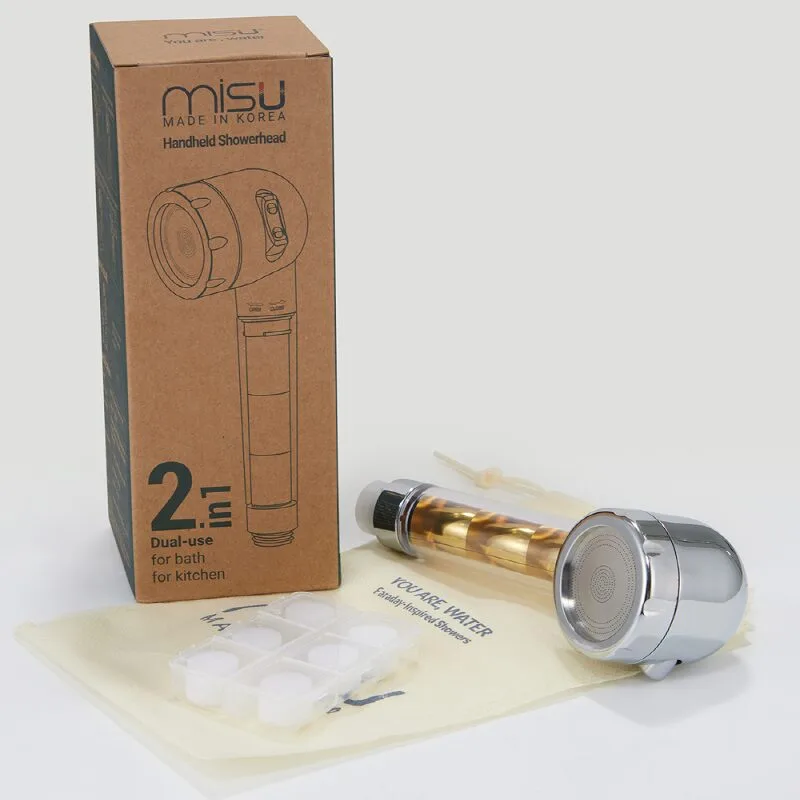
A filtered showerhead works at the point of use, during the shower. The Misu shower, for example, is a portable 2-in-1 kit with replacement capsules. Its multilayer filtration system combines magnetite, calcium sulphite and ceramic minerals and removes chlorine from the shower water. It is an option designed for the bathing experience. Treating water hardness throughout the home is the job of the softener, presented next. More details are on the page for the Misu shower.
Water softener: how it works
The water softener is the equipment that treats hardness at source, where the water enters the home’s plumbing. The most common models work by ion exchange. As the WHO describes, each calcium or magnesium ion in the water is exchanged for two sodium ions on a resin, which salt periodically regenerates. The result is water with fewer limescale-forming minerals in every tap, shower and appliance.
There are two aspects to consider, both mentioned by the WHO:
- Ion exchange increases the sodium content of the treated water. For this reason, some people keep one unsoftened tap for drinking and cooking. Others combine the softener with a purification system in the kitchen.
- One possible alternative is to treat only the hot water line, where limescale causes the most problems. The treatment sits at the inlet of the water heater or hot water cylinder.

Among the solutions available at Filtrarte, the Kinetico water softener is a whole-home softening system. It removes the minerals responsible for limescale and is built to protect plumbing, taps, showers, washing machines, water heaters and boilers.
Comparing the solutions
| Solution | What it does | Where it works | Who it suits best |
|---|---|---|---|
| Cleaning with vinegar and drying | Removes deposits already formed | Surfaces and small appliances | Homes with soft or moderately hard water |
| Tablets and regenerating salt | Protect washing machines | Inside the machines | All homes, as maintenance |
| Filtered showerhead (e.g. Misu) | Removes chlorine from the shower water | The shower only | Anyone who wants to improve the bathing experience |
| Water softener | Reduces hardness by ion exchange | All plumbing downstream | Homes with hard or very hard water |
How to find out the water hardness in your area
The most reliable way to find out your water hardness is to consult the data from the water utility that supplies your home. ERSAR and DECO PROteste suggest several routes:
- Quarterly notices with the analysis results, which water utilities publish in dedicated places, in the regional press or on their website.
- Your water bill, which may include information on the quality of the water supplied.
- A direct request to the water utility, which can provide the results for your supply zone.
- The ERSAR website, which gathers water quality control results by municipality (concelho) and supply zone.
DECO PROteste also points out that some detergent brands print a map on the packaging, with recommended doses according to the water hardness in each region. For an immediate reading at home, simple test kits also exist. They are useful for monitoring the result after installing a softener.
With the value in mg/L of CaCO3 in hand, simply compare it with the WHO table above to see which band your home falls into.
How to choose the right solution for each home
The best solution for limescale depends on the degree of hardness and on what you want to protect. A few scenarios can help guide the decision:
- A flat with soft or moderately hard water: regular cleaning, regenerating salt in the dishwasher and periodic descaling of small appliances are usually enough.
- A house with hard water and heating equipment: a softener, whole-home or on the hot water line only, tends to reduce maintenance and protect hot water cylinders, boilers and machines.
- If you mainly feel discomfort when bathing: the first step is to find out your water hardness. If it is high, the softener works on the cause, and a filtered showerhead can complement it for chlorine.
- If you drink tap water and install a softener: consider an unsoftened water point or a purification system in the kitchen, given the increase in sodium that the WHO mentions.
In any case, a technician’s assessment, based on the water analysis and the home’s consumption, avoids oversized or unsuitable equipment.
Frequently asked questions about limescale in water
Is water with limescale safe to drink?
Yes. ERSAR states that the calcium and magnesium salts responsible for hardness have no harmful effects on human health. The WHO has not set a health-based guideline value for hardness. Accredited laboratories monitor public supply water in Portugal for around 50 parameters. Limescale mainly affects taste, the lather of cleaning products and home maintenance.
What is the difference between hard water and soft water?
Hard water has significant amounts of dissolved calcium and magnesium; soft water has small amounts of these salts. In the classification used by the WHO and ERSAR, water is soft up to 60 mg/L of calcium carbonate. It is moderately hard between 60 and 120, hard between 120 and 180 and very hard above 180.
Does a jug or tap filter remove limescale?
It depends on the equipment. Many household filters work mainly on taste and chlorine, not on hardness. A limescale filter only reduces hardness when it is built to retain calcium and magnesium. To treat the water of the whole home, the most direct solution is a water softener.
Can you drink softened water?
Softening by ion exchange swaps calcium and magnesium for sodium. This increases the sodium content of the water, as the WHO notes. For this reason, many installations keep one unsoftened tap for drinking and cooking. If you follow a salt-restricted diet, you should seek advice from your doctor.
Does hard water cause eczema or hair loss?
There is no evidence to establish such a causal link. Some laboratory studies associate hard water with more surfactant residue on the skin and lower hair strength. However, a British clinical trial with 336 children with eczema, led by the University of Nottingham, found no additional benefit from installing water softeners over 12 weeks. A healthcare professional should assess skin or hair problems.
How can I find out the hardness of the water in my home?
The information is available in the quarterly notices that the water utility publishes, on its website, on your bill or on direct request. The ERSAR website also gathers the results by municipality (concelho) and supply zone. Home test kits allow a quick confirmation.
Is vinegar enough to remove limescale?
For deposits on surfaces and small appliances, white vinegar is a solution recommended by ERSAR itself. In hard water areas, however, deposits return quickly. Vinegar cannot reach the inside of pipes, boilers or hot water cylinders, where only treating the water as it enters the home works.
Content developed by the Filtrarte well-being team.
This article is for information purposes only and does not replace the advice of a healthcare professional or the technical assessment of the water installation by a qualified professional.