Introduction: Why does skin need more attention in summer?
Enjoying the sun in summer requires extra care for our skin, as we are not as green as trees and plants, so intense sun exposure, heat and constant perspiration compromise the skin’s health and its natural balance. The skin needs to be properly protected to minimize the risk of burns, the appearance of spots, skin dehydration and premature ageing due to excessive exposure to ultraviolet solar radiation, which is an aggression and weakens the homeostatic capacity for cell regeneration. So, to keep your skin healthy and glowing, you need to invest in summer skin care, namely moisturizing, cleansing and sun protection, especially by choosing safe times for sun exposure.


Hydration: The Basis for Healthy Skin
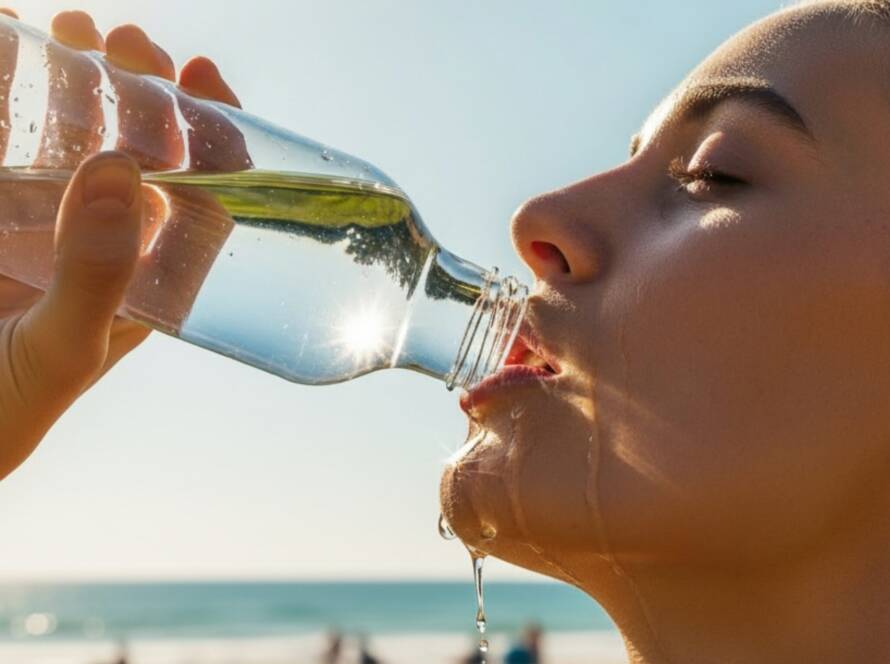
Because heat and sun exposure dehydrate the body and skin, it is essential to keep the body and skin hydrated by drinking more water than usual, eating fresh fruit and vegetables, and taking care of external hydration by applying natural products. While it is essential to keep your skin hydrated, it is equally important to be aware that everything you put on your skin will pass into your bloodstream and therefore into your body. Therefore, read the labeling of sunscreens and moisturizing creams carefully and exclude those that contain toxic products such as: parabens, benzophenones, oxybenzone, octinoxate, homosalate and synthetic fragrances.
As good summer skin care, we can spray it with slightly acidic water, preferably ionized water with a pH of 5.5 (which is the pH of the skin) or hydrogenated water, and use natural, effective and safe products, such as hyaluronic acid and aloe vera (directly from the plant or its extract, in gel or cream form). Hyaluronic acid moisturizes and nourishes the skin; aloe vera is nourishing and promotes intense hydration, and has a soothing, anti-inflammatory and regenerative action, protecting against premature skin ageing.


.
Sun Protection: How, When and Why
Taking care of ourselves is our primary task. Therefore, when it comes to sun exposure, we need to be aware of the choices we make and not “make it easy” – it’s much more important to prevent than to cure sunburn, which can be very serious and is often only detected when it has already “happened”, because the skin damage is progressive and can go unnoticed, for example on beach days when the sun is covered by clouds. Warning: ultraviolet (UV) rays pass through clouds.
Ordinary sunscreens work by using chemical substances that are toxic to the skin and our bodies as they accumulate over time, so you have to weigh up the “cost-benefit” of using them. If you choose to use a non-natural sunscreen, it’s important to choose one with an SPF of 30 or higher. SPF – Sun Protection Factor – 30, means that when applied correctly, the skin will take 30 times longer to turn red than if there were nothing to protect it. Sunscreen should be applied every two hours to the entire exposed surface, including the face, neck, ears and feet. Every time you bathe, you need to reapply the sunscreen.


Avoid Excessive Sun Exposure
In order to take the best care of your skin in summer, you also need to know the following information: the UV radiation that reaches us is of types A and B (UVA and UVB). UVB stimulates the production of vitamin D, while UVA can contribute to cancer. Common sunscreens sold in supermarkets only protect us against UVB, i.e. they protect us from sunburn, but they harm us because they block our body’s ability to produce D3, which is essential for life. There are also sunscreens for UVA/UVB, usually on sale in pharmacies and parapharmacies. The angle of the sun’s rays in relation to the Earth determines how dangerous they are to our bodies. The most critical time is between 11 am and 4 pm. However, the ideal time for D3 production is when the sun is vertically above us, but exposure at this time should not exceed 20 minutes.
At critical times, the use of physical sun protection barriers, such as wide-brimmed hats, UV-protective clothing, UV-protective sunglasses and thick fabric parasols, are measures to be used, as well as natural shade from trees and bushes. With the exception of hats, clothing and sunglasses, all of which have UV protection, the other barriers mentioned do not prevent UV penetration one hundred percent.


After-sun care
After sun exposure, the skin is more sensitive and may even be in different degrees of imbalance – dehydrated, oxidized and inflamed. So you need to take care of it carefully with a warm or cold shower, just with water or with a pH 5.5 soap to remove the sunscreen, applying it with your hands or with a soft sponge or glove. It is contraindicated to exfoliate, use aggressive soap or take prolonged hot showers. It is advisable to use after-sun products that are natural and soothing, such as aloe vera, chamomile and calendula, for example.
The main foods that contribute to the repair and regeneration of oxidized skin are: antioxidant ionized water or hydrogenated water, and antioxidant foods such as berries, grapes, citrus fruits, dark green vegetables, tomatoes, garlic, onions, green tea and cocoa or dark chocolate.


Conclusion
The best summer skin care are preventive measures: sun exposure before 11 a.m. or after 4 p.m.; protect yourself with natural shades, a hat and clothing with UV protection; if you choose sunscreen, choose those that protect against UVB and UVA, with SPF 30 or higher; use post-exposure skin products that are natural and gentle; at the end of the day, remove the sunscreen with a warm shower, using a soft sponge or mitt and pH 5.5 soap; moisturize with water during the day and when you return home, preferably antioxidant or hydrogenated water; and the antioxidant foods mentioned above.
Preventing sunburn and skin ageing is the smartest thing you can do. It’s your skin and your health – take care of it!
Bibliography
- Balogh, T. S., Velasco, M. V. R., Pedriali, C. A., Kaneko, T. M., & Baby, A. R. (2011). Protection from ultraviolet radiation: currently available resources in photoprotection. Anais brasileiros de Dermatologia, 86, 732-742. https://doi.org/10.1590/S0365-05962011000400016
- Garnacho Saucedo GM, Salido Vallejo R, Moreno Giménez JC. Efectos de la radiación solar y actualización en fotoprotección [Effects of solar radiation and an update on photoprotection]. An Pediatr (Engl Ed). 2020 Jun;92(6):377.e1-377.e9. Spanish. doi: 10.1016/j.anpedi.2020.04.014.
- Passeron T, Bouillon R, Callender V, Cestari T, Diepgen TL, Green AC, van der Pols JC, Bernard BA, Ly F, Bernerd F, Marrot L, Nielsen M, Verschoore M, Jablonski NG, Young AR. Sunscreen photoprotection and vitamin D status. Br J Dermatol. 2019 Nov;181(5):916-931. doi: 10.1111/bjd.17992.
- Cabral, A. A. S., dos Santos Oliveira, M. J. V., de Vasconcelos, B. V., da Silva Godeiro, A. L., de Souza, A. L. S., da Silva, J. B., … & Venancio, D. B. R. (2024). Uma revisão integrativa sobre exposição solar e câncer de pele: prevenção e cuidado. Brazilian Journal of Implantology and Health Sciences, 6(2), 1888-1896. https://doi.org/10.36557/2674-8169.2024v6n2p1888-1896